

Gist – (DAY-NRLM)
The Deendayal Antyodaya Yojana-National Rural Livelihoods Mission is a transformative poverty alleviation initiative. It has mobilized over 10 crore rural women into 90.9 lakh Self-Help Groups, catalyzing a financial revolution with over ₹11 lakh crore in credit disbursed. The mission empowers ‘Mahila Kisans,’ promotes rural enterprises, and provides skill training, placing millions of youth in jobs. This women-led model fosters sustainable livelihoods, financial inclusion, and remarkable social change across rural India.
Posted On: 23 OCT 2025 10:24AM
NEW DELHI: In the heart of India’s villages, a quiet revolution is underway. What began as a program to organize the rural poor into Self-Help Groups (SHGs) has evolved into one of the world’s most ambitious and impactful poverty alleviation initiatives. The Deendayal Antyodaya Yojana-National Rural Livelihoods Mission (DAY-NRLM), the flagship program of the Ministry of Rural Development, has moved beyond mere financial aid, architecting a comprehensive ecosystem where millions of rural women are becoming entrepreneurs, farmers, skilled professionals, and community leaders.
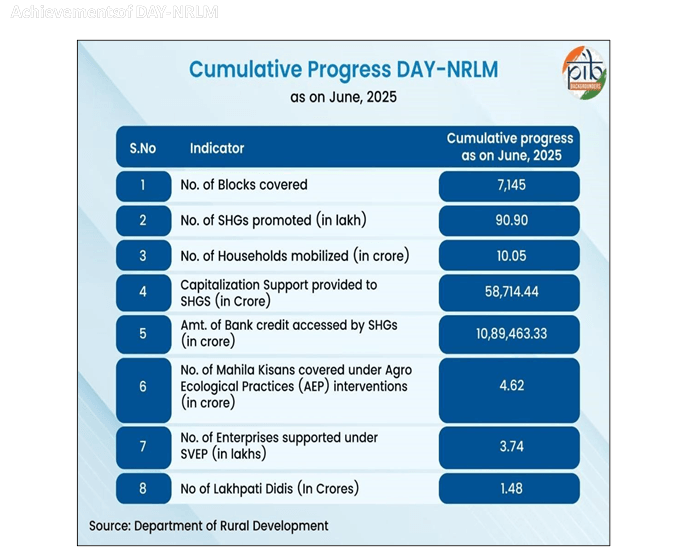
The mission’s staggering statistics tell a story of scale: 10.05 crore rural households mobilized into 90.9 lakh SHGs, over ₹11 lakh crore in credit disbursed, 4.6 crore ‘Mahila Kisans’ empowered, and 11.48 lakh rural youth placed in jobs through skill training. But behind these numbers lie millions of individual stories of transformation, like that of Heinidamanki Kanai from Meghalaya, whose journey from an SHG member to a successful soap entrepreneur with an annual income exceeding ₹1 lakh embodies the mission’s core philosophy of “Antyodaya” – the upliftment of the last person.
I. The Mission’s Architecture: Building from the Ground Up
Launched in 2011 as the National Rural Livelihoods Mission (NRLM) and restructured in 20161 to honour Pandit Deendayal Upadhyaya, DAY-NRLM is a centrally sponsored scheme jointly funded by the central and state governments. It was conceived as a mission-mode intervention to address the structural deficiencies of its predecessor, the Swarnajayanti Gram Swarozgar Yojana (SGSY)2.
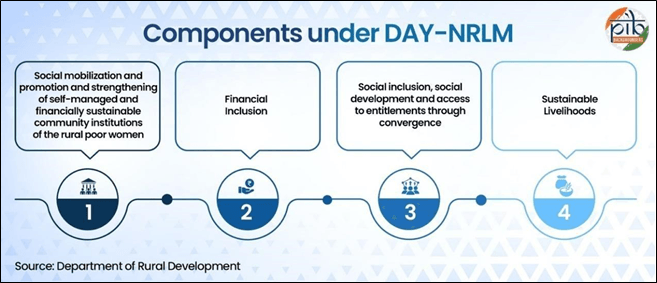
The mission’s strategy is built on four core pillars that create a virtuous cycle of empowerment:
- Social Mobilization and Institution Building: The foundational step involves organizing rural poor women into self-managed and sustainable community institutions, primarily SHGs and their federations at the village and cluster levels.
- Financial Inclusion: Ensuring these institutions gain seamless access to formal banking services, including savings, credit, insurance, and pensions.
- Sustainable Livelihoods: Diversifying and strengthening income sources through both farm-based (agriculture, livestock) and non-farm based (enterprises) activities.
- Social Inclusion and Convergence: Proactively addressing issues of gender, health, nutrition, and sanitation, while ensuring households can access their entitled benefits from other government schemes.
“The mission’s genius lies in its community-driven approach,” explained a senior official from the Ministry of Rural Development. “We don’t impose solutions from the top. We identify potential within the community, train them as resource persons, and let them become the agents of change for their own people. The Krishi Sakhis, Bank Sakhis, and Pashu Sakhis are the real heroes of this story.”
II. The Financial Revolution: ₹11 Lakh Crore and a 98% Repayment Rate
A landmark achievement under DAY-NRLM has been the monumental shift in how formal finance perceives rural women. The disbursement of over ₹11 lakh crore as collateral-free loans to women’s SHGs since 2013-14 is not just a financial statistic; it is a testament to a newfound trust in the creditworthiness of the poor.
This has been facilitated by a multi-pronged strategy:
- Interest Subvention: Providing capital subsidy to make loans affordable.
- Credit Guarantee Fund: Covering lenders against potential losses.
- Bank Sakhis: A force of 47,952 trained SHG members stationed at bank branches to handhold their peers in opening accounts, processing loans, and conducting transactions, thereby bridging the last-mile gap in financial services.
The most compelling evidence of this model’s success is an exceptional loan repayment rate of over 98%, shattering long-held stereotypes about the financial indiscipline of the poor and establishing SHGs as among the most reliable borrowers in the country.
III. Cultivating Prosperity: The Rise of the Mahila Kisan and the Rural Entrepreneur
Beyond credit, DAY-NRLM has triggered a livelihoods revolution. In the agricultural sector, the mission has redefined the identity of rural women farmers by recognizing them as ‘Mahila Kisans’. With 4.62 crore women covered under agro-ecological practices, the mission supports them through a network of 3.5 lakh Krishi Sakhis and Pashu Sakhis—community resource persons who provide last-mile extension services on sustainable farming and animal husbandry.
The formation of 1.95 lakh Producer Groups, benefiting over 50 lakh women, has enabled collective investment, production, and, crucially, marketing, allowing smallholders to achieve economies of scale.
In the non-farm sector, the Start-up Village Entrepreneurship Programme (SVEP) has ignited the entrepreneurial spirit in rural India, supporting the establishment of 3.74 lakh enterprises across 282 blocks. These range from handicrafts and food processing to local service provision, creating diverse income streams and reducing dependence on agriculture.
V. Skilling a Generation: Linking Rural Youth to the Mainstream Economy
Recognizing that sustainable poverty alleviation requires engaging the youth, DAY-NRLM incorporates two powerful skill development arms:
- Deen Dayal Upadhyaya Grameen Kaushalya Yojana (DDU-GKY): This placement-linked scheme provides quality skill training to rural youth aged 15-35, ensuring they are equipped for jobs in the formal sector. As of June 2025, a total of 17.50 lakh candidates have been trained, with 11.48 lakh already placed in jobs with minimum-wage compliance.
- Rural Self Employment Training Institutes (RSETIs): These bank-sponsored institutes focus on fostering entrepreneurship. Since their inception, they have trained a massive 56.69 lakh candidates, with 40.99 lakh settling into self- or wage-employment.
State-wise Leadership in Skilling:
- Under DDU-GKY, Uttar Pradesh leads in training (2,44,528), while Odisha excels in placements (1,77,165).
- For RSETIs, Uttar Pradesh is the undisputed leader, having trained 7,55,966 candidates and settled 5,54,877 entrepreneurs.
V. The State-Specific Surge: A Pan-India Movement with Local Champions
The mission’s success is not uniform but tailored, with different states emerging as leaders in various domains.
- Social Mobilization: Bihar, Uttar Pradesh, and Andhra Pradesh have mobilized the largest number of women into the SHG fold.
- Financial Inclusion: In FY 2024-25, Uttar Pradesh and Bihar led in providing capitalization support to SHGs, while Andhra Pradesh dominated in facilitating bank loans, securing a staggering ₹34,83,725 lakh.
- Sustainable Livelihoods: Maharashtra leads in empowering ‘Mahila Kisans’ (12.97 lakh), while Assam is the frontrunner in promoting non-farm enterprises under SVEP (9,557 enterprises).
VI. From Local to National: The SARAS Melas and Market Linkages
A critical challenge for rural producers has been access to markets. DAY-NRLM addresses this through strategic initiatives like the National and State-level SARAS Aajeevika Melas. These fairs provide a direct platform for SHG members to sell their products, understand urban consumer preferences, and build brands. The most recent mela was held in New Delhi from September 5-22, 2025, showcasing the finest rural handicrafts and food products from across the country.
Furthermore, institutions like the National Institute of Rural Development and Panchayati Raj (NIRD&PR) are building advanced marketing capacities. Over the last three years, NIRD&PR has conducted 44 specialized training programs to sharpen the marketing acumen of SHG members and rural entrepreneurs.
VII. Conclusion: A Sustainable Model for Inclusive Growth
The Deendayal Antyodaya Yojana-National Rural Livelihoods Mission has transcended its identity as a government scheme. It has cultivated a powerful, self-perpetuating ecosystem of women-led institutions that drive financial inclusion, livelihood diversification, and social change. By investing in social capital, it has demonstrated that the poor are not a liability but an untapped reservoir of enterprise and resilience.
The journey of Heinidamanki Kanai from Meghalaya is no longer an isolated anecdote; it is a replicable model. As these millions of women gain economic agency, the impacts ripple outwards—improving family nutrition, educating children, and transforming power dynamics within households and communities. DAY-NRLM has not just provided a safety net; it has built a springboard, propelling rural India, and especially its women, towards a future of dignity, self-reliance, and prosperity.
Takeaways
- Mobilized 10.05 crore rural households into 90.9 lakh SHGs across India.
- Supported 4.6 crore Mahila Kisans and 3.74 Lakh enterprises through entrepreneurship programs.
- Trained 17.5 lakh rural youth under DDU-GKY, with a total of 11.48 lakh already placed.
- Deployed 47,952 Bank Sakhis to boost rural financial inclusion and credit access.
- Promoted sustainable livelihoods through agriculture, non-timber forest produce, livestock, and non-farm enterprises.
- Disbursed over ₹11 Lakh Crore as credit to Women SHGs with a repayment rate of over 98%.
Read : Deendayal Antyodaya Yojana- National Rural Livelihoods Mission – PIB
Read: What is a Self Help Group (SHG) in DAY-NRLM ?
Read: Visit https://inworldnews.com/ for more
- In 2016, the National Rural Livelihoods Mission (NRLM) (launched in 2010) was renamed the Deendayal Antyodaya Yojana – National Rural Livelihoods Mission (DAY-NRLM). The restructuring in 2016, which also saw a parallel renaming of the urban component to Deendayal Antyodaya Yojana – National Urban Livelihoods Mission (DAY-NULM), aimed to reduce poverty by organizing the rural poor into strong self-help groups (SHGs) and enabling them to access financial services and diversified livelihood opportunities.
Initial launch:
The NRLM was launched in 2010 as a mission-mode scheme, replacing the earlier Swarnajayanti Grameen Swarojgar Yojana (SGSY).
Restructuring and renaming:
On March 29, 2016, the program was renamed DAY-NRLM to emphasize its goal of “Antyodaya” (upliftment of the last person).
Core objectives:
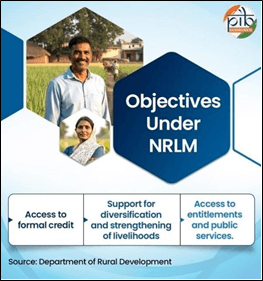
The program aims to reduce poverty by building strong grassroots institutions of the poor, especially women, and helping them access financial services, sustainable livelihood opportunities, and social and political empowerment.
Implementation:
The mission is implemented through various components, including promoting self-help groups (SHGs) and providing them with capital support and technical assistance.
Funding:
DAY-NRLM is a centrally sponsored scheme jointly funded by the central and state governments. ↩︎ - Swarnjayanti Gram Swarozgar Yojana (SGSY) was an umbrella scheme launched in 1999-2000 to provide self-employment opportunities to families living below the poverty line in rural areas. Its objective was to organize Self-Help Groups (SHGs), provide them with training, credit, technology, and infrastructure and marketing support. The scheme was later reorganized intothe National Rural Livelihoods Mission (NRLM).
Key Points
beginning:
This scheme was launched on April 1, 1999.
Target:
Its main objective was to lift rural families living below the poverty line out of poverty by providing them income-generating assets.
Inclusive Programs:
SGSY was a comprehensive package covering all aspects of self-employment, such as: Formation of Self Help Groups (SHGs)
Training
Loan and Credit-cum-Subsidy Programme
Technology and Infrastructure Support
Marketing Support
Progress:
Under this scheme, the target was to ensure an income of at least ₹2000 per month to the beneficiaries.
Reorganization:
Later, the scheme was renamed as National Rural Livelihood Mission (NRLM). ↩︎