
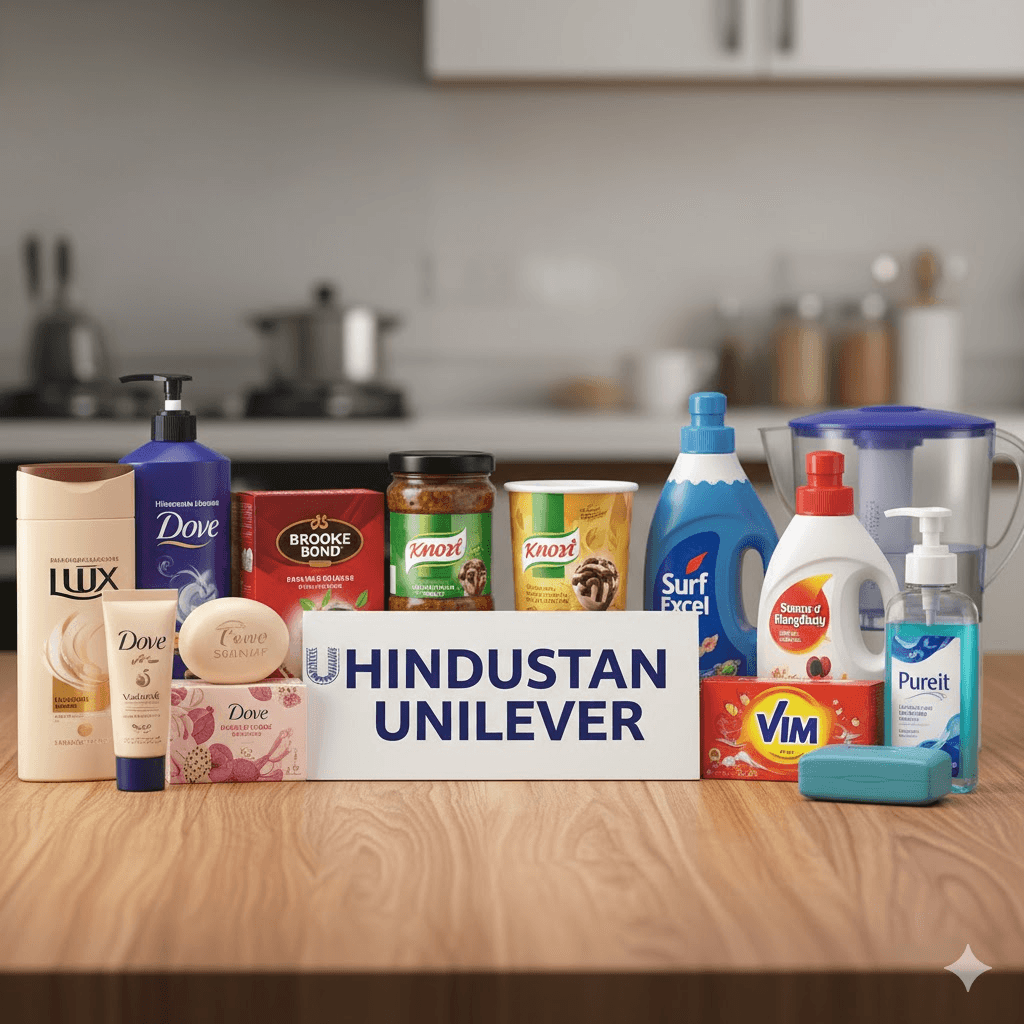
Hindustan Unilever Limited (HUL) presented its second-quarter (Q2) results for the fiscal year 2025-26 on October 23, 2025. The investor presentation, provides a detailed overview of the company’s performance, operating context, and strategic priorities. The results reveal a complex picture, with a positive-looking profit growth driven by an exceptional item, while key underlying metrics show the impact of recent market disruptions. The presentation outlines the company’s focus on navigating these headwinds and re-establishing a clear path to volume-led growth under the leadership of its new Chief Executive Officer and Managing Director, Priya Nair. Read Complete Investor Presentation here
Overall Financial Highlights for Q2 FY26
The consolidated results for the quarter show a reported turnover of ₹16,061 crore, representing a 2% increase in sales growth compared to the same period in the previous year. The company’s Underlying Sales Growth (USG) was also 2%, while the Underlying Volume Growth (UVG) was flat. This indicates that most of the growth was driven by pricing rather than an increase in the number of products sold.
The Profit After Tax (PAT) showed a year-on-year growth of 4%, reaching ₹2,694 crore. However, the presentation reveals that this positive figure was significantly influenced by a one-time gain. The “Profit Before Tax” was ₹3,570 crore, a 1% increase over the previous year. The reported PAT before exceptional items was ₹2,482 crore, which is a -4% decline compared to the previous year. This divergence highlights that while the overall profit figure appeared positive, the company’s core profitability, excluding one-off gains, faced challenges in the quarter. The EBITDA margin was 23.2%, a decrease of 90 basis points year-on-year.
#MarketToday | Rs 4,465 crore dividend payout! 10.53 lakh retailers get Diwali bonanza from this bluechip. Hindustan Unilever Q2 results & dividend: The multinational FMCG major announced its quarterly earnings for September 2025 quarter and… https://t.co/S9HUAAGp27
— Business Today (@business_today) October 23, 2025
#2QWithCNBCTV18 | Hindustan Unilever reports an in-line set of Q2FY26 earnings
— CNBC-TV18 (@CNBCTV18News) October 23, 2025
Net profit at Rs 2,690 cr beats estimates, includes one-time gain of Rs 184 cr
The management says
-Will be obsessed with volume-led growth@blitzkreigm@HUL_News #CNBCTV18Market #earnings pic.twitter.com/XIa9c5y7G2
Operating Context and Market Dynamics
The presentation attributes the subdued performance, particularly the flat volume growth, to a challenging operating context. The key factors influencing the quarter were:
- New Age GST Reforms: The implementation of GST reforms caused “transitory business disruption”. The company notes that approximately 40% of its portfolio transitioned to a 5% GST slab. This led to trade de-stocking and delayed consumer purchasing as the market and supply chains adjusted to the new pricing structure. HUL’s approach was to “agilely execute to pass on the entire benefit to consumers” and extend support to the trade with clear pricing communications. The presentation anticipates that these GST reforms will eventually act as a “consumption tailwind” for increasing disposable income and improving consumer sentiment.
- Prolonged Monsoon: The presentation identifies “prolonged and intense monsoon conditions” that affected parts of the country as another key headwind. This had a direct impact on certain product categories, such as the Ice Cream business, which saw a decline in turnover as a result.
Segment-Wise Performance Breakdown
The performance of HUL’s four main business segments varied:
- Home Care: With a turnover of ₹5,664 crore, this segment had a 19% margin. The underlying sales growth was flat, despite mid-single-digit volume growth driven by the liquids portfolio, particularly in fabric wash. The turnover was offset by pricing actions taken in earlier periods.
- Beauty & Wellbeing: This segment had a turnover of ₹3,732 crore with a 28% margin. It showed a 5% Underlying Sales Growth and a flat Underlying Volume Growth. Skin Care and Colour Cosmetics performed well with “high-single digit growth,” while the Hair Care turnover declined due to the GST rate rationalization.
- Personal Care: With a turnover of ₹2,425 crore and a 20% margin, this segment’s Underlying Sales Growth was flat. The Underlying Volume Growth, however, saw a “high-single digit decline”. This was primarily due to the transitory impact of the GST transition, though Skin Cleansing delivered a competitive performance.
- Foods: This segment, with a turnover of ₹3,869 crore and a 16% margin, had a USG of 3% and UVG1 in the “low-single digit” range. Beverages maintained double-digit growth, but Packaged Foods were affected by the GST transition, and the Ice Cream business declined due to the extended monsoon.
Strategic Outlook and Future Focus
The presentation, led by new CEO and MD Priya Nair, highlights a clear strategic direction moving forward. The company’s key priority is “focussed on volume-led growth”. The strategy involves a “radical segmentation of consumers” into “Power Spenders,” “Premiumisers,” and “Democratisers”. It also includes a focus on modernizing core and building more premium brands, accelerating the “future-proofing” of its marketing and sales capabilities, and “continuing to double down on high-growth demand spaces”.
Regarding the near-term outlook, the company expects the GST-related disruptions to continue into October, with “normal trading conditions” anticipated from early November onwards. If commodity prices remain stable, the company projects a “low-single digit” price growth. Overall, HUL expects the “second half of FY’26 to be better than the first half” and states that the EBITDA margin is expected to “remain at the current levels” to support continued investment in the business. The presentation affirms that HUL possesses a “robust business model with enduring strengths,” including a competitive advantage, an unbeatable portfolio, and a deep distribution network.
Disclaimer: Not a SEBI Registered Analyst
I am not a SEBI Registered Investment Adviser or Research Analyst. All information shared is for educational and informational purposes only and is not intended as a substitute for professional financial advice. All opinions expressed herein are based on my personal observations and research. They do not constitute a recommendation or a solicitation to buy, sell, or hold any security. Investments in the securities market are subject to market risks. The value of investments may go up or down. Past erformance is not indicative of future results.
You are solely responsible for your own investment decisions. You should conduct your own research and consult with a qualified financial advisor before making any investment based on the information provided here.
I may or may not hold positions in the securities mentioned. This is a personal blog/platform, and I have no relationship with the companies mentioned unless explicitly stated – Editor
Visit https://inworldnews.com/ for more
- Underlying Sales Growth (USG)
USG measures the increase in a company’s sales for a given period, excluding factors that can distort organic growth, such as:
Acquisitions: Sales from newly acquired companies are removed.
Disposals: Sales from businesses that have been sold off are excluded.
Currency fluctuations: The impact of changes in foreign exchange rates is neutralized.
This provides a clearer picture of how much the company’s core business is growing, as a combination of volume, pricing, and product mix improvements.
Underlying Volume Growth (UVG)
UVG measures the increase in the total quantity of products sold. Importantly, UVG also accounts for changes in the product mix, which is the shift in sales towards either higher-priced or lower-priced items.
UVG reveals whether a company’s sales are being driven by:
Strong demand: Selling more units of a product (pure volume growth).
Product mix: Selling a different mix of products. For example, if a company sells the same number of units but shifts consumers towards more expensive, premium products, this would be reflected positively in the UVG.
The relationship between USG and UVG
USG is a product of both UVG and changes related to pricing and mix. A simple, though not mathematically exact, way to understand the relationship is:
USG
≈
is approximately equal to
≈ UVG + Price/Mix Growth
A more precise calculation uses multiplication since the effects are compounding:
(1 + USG) = (1 + UVG) × (1 + Price/Mix Growth)
By comparing USG and UVG, you can gain insights into a company’s business strategy:
High USG and High UVG: The company is successfully growing both its sales volume and its overall revenue, suggesting strong market demand.
High USG and Low/Flat UVG: The company is increasing revenue by raising prices or shifting its product mix towards higher-value items. This indicates strong pricing power, but also suggests the volume of sales is stagnating.
Low USG and High UVG: The company is selling more products (higher volume), but it is doing so at lower prices, perhaps through discounts or promotions. This can negatively impact revenue and margins. ↩︎