
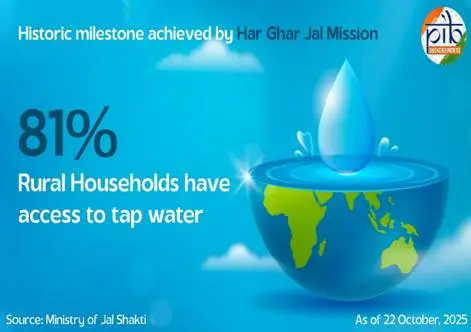
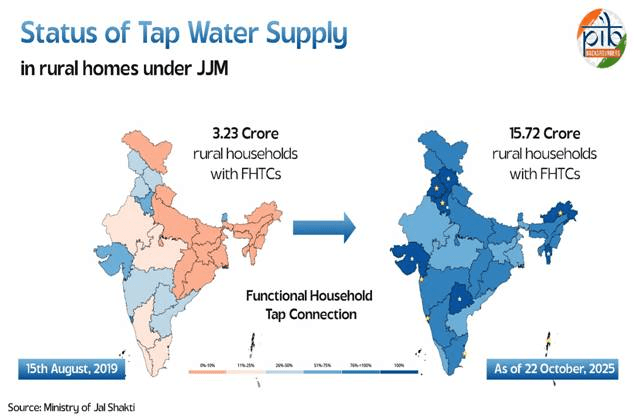
Gist – India’s Jal Jeevan Mission has achieved a monumental leap, providing safe tap water to over 15.72 crore (81%) rural households—a dramatic increase from just 3.23 crore in 2019—through a massive ₹2.08 Lakh Crore investment. This transformative initiative is liberating women, saving an estimated 5.5 crore hours daily once spent fetching water, drastically improving public health by averting thousands of waterborne disease deaths, and boosting the rural economy by generating crores of person-years of employment, all while ensuring sustainability and water quality through robust community participation and digital monitoring.
NEW DELHI, OCTOBER 26: In a landmark achievement for rural infrastructure and public welfare, the Government of India’s Jal Jeevan Mission (JJM)1 has successfully provided safe tap water connections to over 15.72 crore rural households, covering more than 81% of the country’s rural population, according to an official release today. Read PIB Press Release here.
Launched in 2019 with a massive central outlay of ₹2.08 Lakh Crore, the mission has executed one of the world’s fastest-ever expansions of drinking water infrastructure, adding 12.48 crore new household connections in just six years.
From Scarcity to Security: A Nationwide Transformation
At the time of its launch on August 15, 2019, only 3.23 crore (16.71%) rural households had access to tap water. The mission’s rapid progress means that today, a vast majority of rural families have a reliable source of clean water at their doorstep.
“The Jal Jeevan Mission has become a major development parameter to provide water to every household,” Prime Minister Narendra Modi has stated, highlighting the scheme’s role in improving ease of living and adding pride and dignity to rural families.
Multi-faceted Impact: Health, Women, and Employment
The mission’s success extends far beyond infrastructure, delivering profound social and economic benefits:
- Liberating Women: The World Health Organization (WHO) estimates that providing tap connections saves an estimated 5.5 crore hours every day previously spent fetching water, a burden that fell predominantly on women. SBI Research notes this has enabled 9 crore women to stop fetching water, leading to a 7.4%-point increase in their participation in agriculture and allied activities.
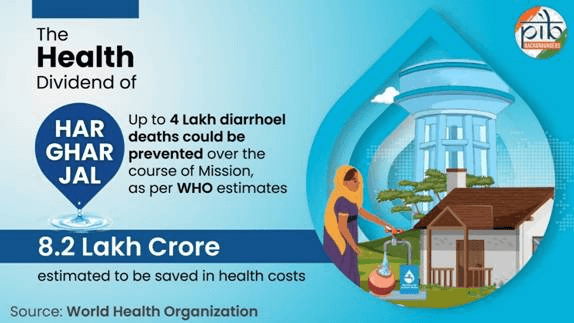
- Saving Lives: WHO projects that universal coverage of safe drinking water could avert nearly 4 lakh deaths from diarrheal diseases and save 14 million Disability-Adjusted Life Years (DALYs), translating to potential health cost savings of up to ₹8.2 lakh crore.
- Boosting Employment: According to IIM Bangalore and the International Labour Organization, JJM has the potential to generate nearly 3 crore person-years of employment during its implementation.
Robust Monitoring and Community Participation
A key pillar of JJM’s success is its emphasis on water quality and community ownership.
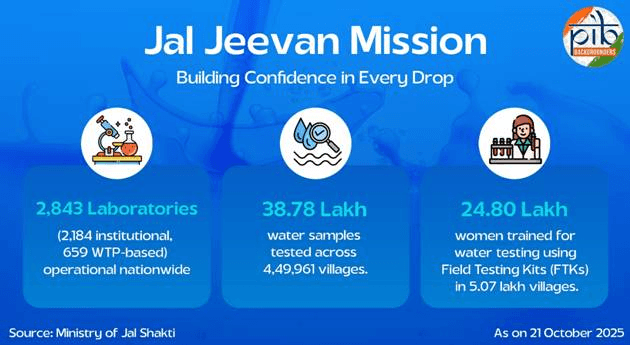
- Quality Assurance: A network of 2,843 water testing laboratories across India tested 38.78 lakh water samples in 2025-26 to ensure safety.
- Women as Water Guardians: Nearly 25 lakh women have been trained to use Field Testing Kits (FTKs) in over 5 lakh villages, empowering them as first-line defenders of water quality in their communities.
- Digital Governance: The mission is leveraging technology through platforms like the upgraded Rural Piped Water Supply Schemes (RPWSS) module and West Bengal’s ‘Jal Mitra’ app, which bring transparency and real-time monitoring to water supply management.
State-Wide Success and Sustainability
Eleven States and Union Territories—including Goa, Haryana, Gujarat, Himachal Pradesh, and Punjab—have already achieved 100% tap water coverage. The mission also ensures water access in 9.23 lakh schools and 9.66 lakh Anganwadi centres.
Crucially, JJM integrates source sustainability measures like greywater management, rainwater harvesting, and water conservation, ensuring the long-term viability of water sources.
Grassroots Success Stories
The mission’s impact is visible in villages across India:
- In Mhapan, Maharashtra, a women’s self-help group manages the entire water scheme, achieving 100% bill collection and earning ₹1.7 lakh, making it a self-sustaining enterprise.
- In Wokha, Nagaland, communities are adopting a “source-first” approach, building trenches and planting trees to protect their catchments and ensure a continuous water supply.
- In Borbori, Assam, the introduction of piped water reduced waterborne disease cases from 27 to zero within two years, with households contributing ₹1 per day for maintenance.
Conclusion
The Jal Jeevan Mission is rapidly turning the vision of Har Ghar Jal (tap water to every home) into a tangible reality. By combining rapid infrastructure rollout with a strong focus on community participation, quality, and sustainability, the mission is not just delivering water, but is also fostering a new era of health, dignity, and economic opportunity in rural India.
Sources: Press Information Bureau, Ministry of Jal Shakti, WHO Reports, SBI Research.
Visit https://inworldnews.com/ for more
- The Jal Jeevan Mission (JJM) is a flagship initiative launched by the Government of India in August 2019 to provide safe and adequate drinking water through tap connections to every rural household. The mission aims to supply 55 litres of water per person per day on a regular and long-term basis. Following significant progress, the mission has been extended until 2028, with a renewed focus on sustainability and infrastructure quality.
Objectives
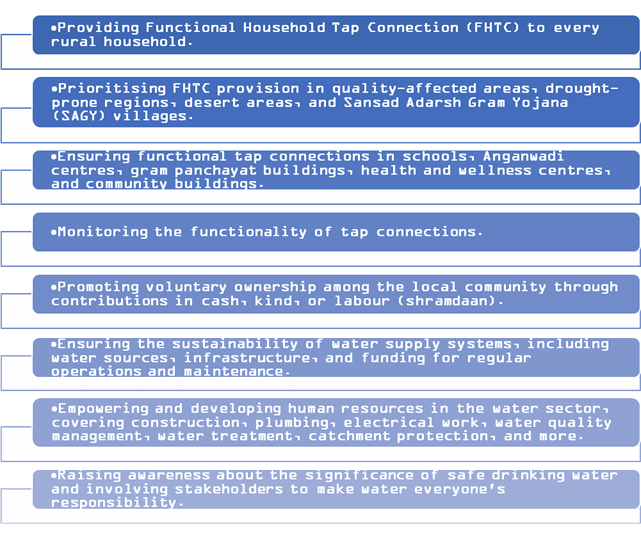
“Har Ghar Jal” (Water to Every Household): To ensure a functional household tap connection (FHTC) for every rural home and public institution like schools, anganwadi centres, and health centres.
Water Quality Assurance: To provide water of a prescribed quality by setting up water quality testing laboratories at district and state levels. Field Test Kits (FTKs) are also provided to train and empower local communities to conduct their own water quality tests.
Source Sustainability: To implement mandatory measures such as rainwater harvesting, groundwater recharge, and greywater management for the long-term sustainability of water sources.
Community Participation: To involve Gram Panchayats and Village Water and Sanitation Committees (VWSCs) in planning, implementing, and managing local water supply systems.
Ease of Living: To free women and children from the daily burden of fetching water, thereby improving health, education, and socio-economic conditions.
Progress and impact
Coverage: As of October 25, 2025, over 15.72 crore (81.19%) of India’s 19.36 crore rural households have tap water connections, compared to only 16.71% in 2019.
Health: The World Health Organization (WHO) estimates that providing safely managed drinking water could prevent nearly 400,000 deaths from diarrhoeal diseases annually. Studies also suggest it could lead to a significant reduction in child mortality.
Time Savings: The mission is estimated to save over 5.5 crore hours of time daily for women in rural India, who previously spent this time collecting water.
State Achievements: Several states and Union Territories, including Goa, Telangana, Gujarat, and Haryana, have achieved 100% tap water coverage for rural households.
Extension: The mission has been extended until 2028 to focus on the remaining households and ensure the quality and sustainability of the infrastructure.
Funding
Budget: The total estimated cost of the mission is INR 3.60 lakh crore, with a central outlay of ₹2.08 lakh crore.
Central and State Share: The cost-sharing ratio between the Centre and States varies:50:50: For most states. 90:10: For Himalayan and North-Eastern States. 100:0: For Union Territories.
↩︎