
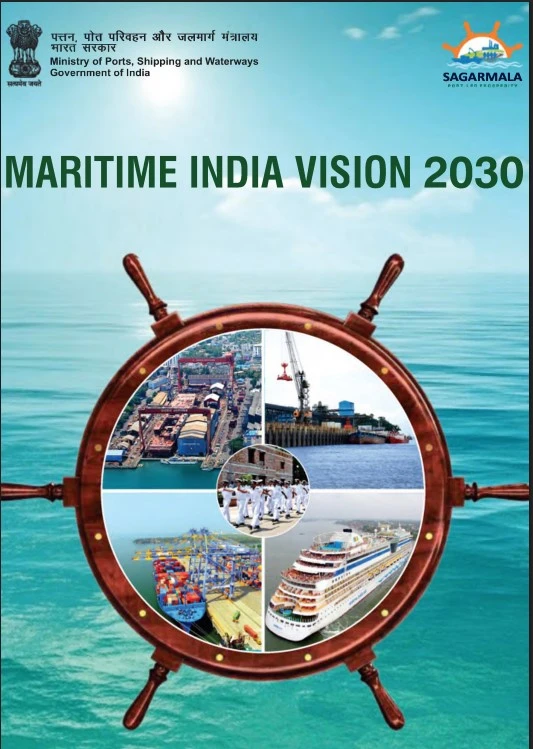

Gist – India is aggressively transforming its maritime sector, leveraging its vast coastline to become a global maritime leader by 2047. Building on the success of the Maritime India Vision 2030, which has already driven record growth in port capacity, efficiency, and inland waterways, the nation is now executing the ambitious Amrit Kaal Vision 2047. This long-term strategy, backed by trillions of rupees in investment—including recent packages for shipbuilding and landmark MoUs—aims to modernize infrastructure, boost domestic shipping, and embrace green technology, positioning India not just as a participant but as a dominant force in global trade and shipbuilding.
NEW DELHI, OCTOBER 26, 2025 (PIB) – The Government of India today unveiled the sweeping progress and ambitious future of its maritime sector, outlining a strategic journey from the ongoing Maritime India Vision 2030 (MIV 2030) to the transformative Maritime Amrit Kaal Vision 2047, which aims to position the nation among the world’s top maritime powers.
The announcement, backed by robust data and recent mega-investments, underscores the critical role of the maritime sector, which facilitates 95% of India’s trade by volume and 70% by value. Please Read PIB Press release here

A Decade of Unprecedented Transformation
An official review of the period from 2014 to 2025 reveals a sector in the midst of a historic boom:
- Port Capacity & Efficiency: Port capacity nearly doubled to 2,762 MMTPA, with cargo handling surging to a record 1,594 MMT. The average vessel turnaround time was slashed from 93 hours to just 48, boosting global competitiveness.
- Financial Health: The net annual surplus of major ports skyrocketed from ₹1,026 crore to ₹9,352 crore, reflecting superior operational efficiency.
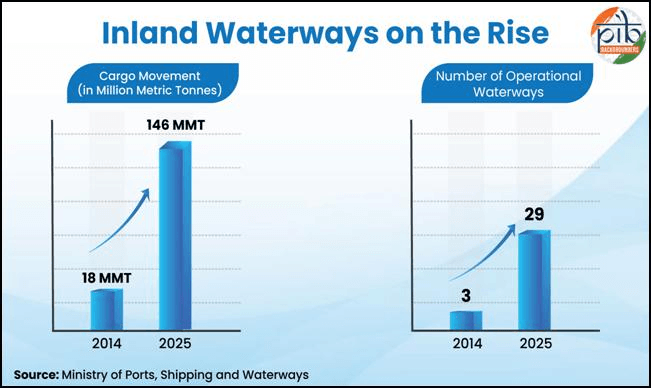
- Shipping & Inland Waterways: The Indian-flagged fleet grew to 1,549 vessels, while cargo on inland waterways exploded by 710%, from 18 MMT to a record 146 MMT in 2025. The number of operational waterways jumped from 3 to 29.
- Seafarer Strength: India solidified its place as a global crewing hub, with its seafarer workforce growing from 1.25 lakh to over 3 lakh, now accounting for 12% of the global total.
Maritime India Vision 2030: The Engine of Growth
Launched in 2021, MIV 2030 serves as the foundational blueprint for this growth. The vision encompasses over 150 strategic initiatives, backed by a projected investment of ₹3–3.5 lakh crore. A recent landmark package of ₹69,725 crore has been specifically allocated to boost domestic shipbuilding, a key strategic objective.
“The Maritime India Vision is not just about moving cargo; it is about moving India forward. It is a catalyst for trade, investment, and employment, directly contributing to our national economic growth,” a senior official stated.
Financing the Wave of Development
Key financial instruments are being deployed to fuel this expansion:
- Maritime Development Fund (MDF): A ₹25,000 crore corpus for long-term financing of shipping tonnage and shipbuilding.
- Shipbuilding Schemes: The revamped Shipbuilding Financial Assistance Scheme (SBFAS) and the Shipbuilding Development Scheme (SbDS), with a combined outlay of over ₹44,700 crore, aim to make Indian shipyards globally competitive.
- Sagarmala Programme: This flagship initiative has 840 projects worth ₹5.8 lakh crore in the pipeline by 2035, with 272 projects worth ₹1.41 lakh crore already completed.
Looking Ahead: Amrit Kaal 2047 and Recent Milestones
Building on the momentum of MIV 2030, the government has charted an even more ambitious course with the Maritime Amrit Kaal Vision 2047. This long-term roadmap envisions investments of nearly ₹80 lakh crore to position India as a top global maritime and shipbuilding nation by the centenary of its independence.
The sector’s potential was recently on full display during the “Samudra Se Samriddhi” event in September 2025, where 27 MoUs were signed, unlocking investment potential of over ₹66,000 crore and paving the way for 1.5 lakh jobs. Key projects include a new Greenfield Port at Bahuda, Odisha (₹21,500 crore), a Water Metro Project in Patna (₹908 crore), and a strategic vessel-owning joint venture to reduce dependence on foreign ships.

A Global Stage: India Maritime Week 2025
The nation’s maritime ambition will take center stage next week at India Maritime Week 2025 in Mumbai. The event, expected to draw over 100,000 delegates from more than 100 countries, will serve as a premier platform for showcasing India’s progress and forging new global partnerships.
Conclusion: From Vision to Voyage
With a clear strategy, massive investment, and a decade of proven results, India is decisively turning its vast coastline into a driver of global trade and sustainable prosperity. The journey from Maritime India Vision 2030 to Amrit Kaal 2047 marks the nation’s determined voyage from a regional player to a navigator of the future global maritime order.
*About the Ministry of Ports, Shipping and Waterways:
The Ministry of Ports, Shipping and Waterways is the nodal agency for the formulation and administration of the rules, regulations, and laws relating to ports, shipping, and waterways in India. It is responsible for the development and regulation of maritime infrastructure and services.
Visit https://inworldnews.com/ for more