

Gist – On October 23, 2025, the Union Health Secretary launched three specialized training modules for managing chemical emergencies. Developed by the NCDC with the NDMA and WHO, the modules aim to standardize the response from preparedness to hospital care. This initiative seeks to equip public health professionals, responders, and policymakers with critical skills to effectively handle chemical incidents, thereby enhancing national preparedness, minimizing health impacts, and strengthening India’s overall health security and resilience.
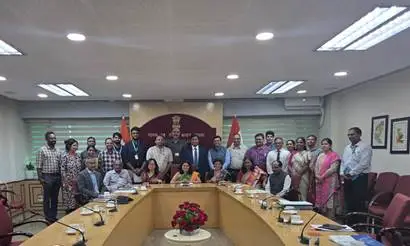
NEW DELHI, October 23, 2025: In a decisive stride towards fortifying India’s public health defences against the silent and insidious threat of chemical disasters, the Union Health Secretary, alongside a consortium of national and international experts, today launched a comprehensive set of training modules on the Public Health Management of Chemical Emergencies. The event, held at Nirman Bhawan, marks a paradigm shift in the country’s approach to handling industrial and accidental chemical incidents, moving from reactive response to proactive, prepared resilience.
The Secretary for Health and Family Welfare, presiding over the high-level gathering, underscored the criticality of this initiative in the context of India’s rapidly expanding industrial economy. “Chemical emergencies pose a significant and evolving threat to public health, environmental safety, and societal stability,” he stated, addressing a room filled with senior officials from various line ministries, national agencies, and experts from the private sector, industry, and academia. “In our present fast-growing industrial economy, updating and keeping oneself prepared for any such emergencies is of paramount importance. These modules are not just documents; they are a strategic arsenal for our frontline warriors.”
The newly launched compendium, a first-of-its-kind holistic framework, comprises three specialized training modules developed by the National Centre for Disease Control (NCDC) under the Ministry of Health and Family Welfare (MoHFW). This ambitious project was undertaken in strategic collaboration with the National Disaster Management Authority (NDMA) and with crucial technical support from the World Health Organization (WHO) India Country Office.
A Tri-Shakti Approach to a Complex Challenge
The three modules are designed to create a seamless, interlocking chain of survival and management, addressing every critical phase of a chemical emergency:
- Module 1: Preparedness, Surveillance, and Response for Public Health Management of Chemical Emergencies: This foundational module serves as the strategic blueprint. It focuses on the systems and protocols needed before a disaster strikes. It covers risk assessment, the development of robust surveillance mechanisms to detect chemical exposures early, the formulation of response plans at state and district levels, inter-agency coordination, and public communication strategies to prevent panic and misinformation.
- Module 2: Pre-Hospital Management of Chemical Emergencies: This module is the tactical guide for the first responders—the police, fire services, National Disaster Response Force (NDRF) personnel, and ambulance crews who are the first to arrive at the scene of an incident. It provides critical knowledge on scene safety and management, triage in a contaminated environment, immediate decontamination procedures, and initial life-support measures for a wide range of chemical exposures, all aimed at stabilizing victims for transport.
- Module 3: Medical Management of Chemical Emergencies: This clinical module is targeted at doctors, nurses, and hospital administrators. It delves deep into the diagnosis and treatment of specific chemical poisonings, the setup and operation of decontamination units at hospital gates, the management of mass casualty influx, and the long-term health monitoring of survivors, addressing both acute toxicity and chronic health effects.
Bridging a Critical Gap in National Security
The launch event highlighted a stark reality: the nature of threats facing India has evolved. While the country has a established disaster management framework for natural calamities like floods and cyclones, the specific public health intricacies of chemical emergencies—ranging from industrial leaks and transportation accidents to potential acts of terrorism—required a more specialized and standardized national protocol.
A senior official from the NDMA explained, “A chemical disaster is not like an earthquake. The danger is often invisible, can spread through air and water, and has unique medical consequences. The response cannot be generic. It requires specific knowledge about toxicology, antidotes, and containment. These modules finally provide that standardized, evidence-based knowledge, ensuring that a responder in Visakhapatnam and a doctor in Varanasi are on the same page.”
The modules aim to equip a diverse range of professionals—public health experts, medical officers, paramedics, emergency responders, and policymakers—with the necessary knowledge, skills, and operational tools for the timely and effective management of chemical incidents. The ultimate goal is to minimize mortality, morbidity, and the long-term societal impact of such events.
Aligning with Global Health Security
The initiative also carries significant weight in the international arena. By strengthening India’s core capacities in chemical risk preparedness and response, the country is directly enhancing its compliance with the International Health Regulations (IHR 2005). The IHR is a legally binding international instrument designed to help the global community prevent and respond to acute public health risks that have the potential to cross borders and threaten people worldwide.
A representative from WHO India lauded the effort, stating, “Today’s launch is a testament to India’s leadership in public health preparedness. Chemical emergencies are a quintessential global health security threat. By building a resilient system here, India is not only protecting its own citizens but also contributing to regional and global health security. The WHO is proud to have provided the technical support to make this a reality, aligning the content with global best practices.”
A Confluence of Expertise for a Unified Mission
The launch event was more than a ceremonial function; it was a symbolic convergence of the entire ecosystem required to manage complex emergencies. The presence of officials from multiple central ministries—including Environment, Industry, and Transport—signaled a break from siloed operations towards an integrated, ‘Whole-of-Government’ approach.
Furthermore, the involvement of academia and private industry experts ensured that the modules are not only theoretically sound but also grounded in the practical realities of India’s industrial landscape. Industry representatives provided insights into on-ground risks and operational challenges, while academicians contributed cutting-edge research in toxicology and emergency medicine.
The Road Ahead: From Launch to Lifesaving Action
The launch of the modules is the beginning of a massive national capacity-building mission. The next and most critical phase involves the rapid and widespread dissemination and implementation of this training across the country.
The Union Health Secretary outlined the future roadmap, indicating that the NCDC, in partnership with state health departments and training institutions, will now roll out a massive ‘Training of Trainers’ (ToT) program. “These modules will be translated into action through a cascading model. We will first master-train a core group of experts from every state. These experts will then fan out to train district-level officials, medical college faculty, and first-response teams. Our aim is to create a self-sustaining, ever-expanding network of competency,” he elaborated.
The training is expected to be integrated into the regular curriculum of medical and nursing colleges, as well as the mandatory training cycles for disaster response forces.
Building a Self-Reliant, Resilient Nation
In his concluding remarks, the Health Secretary linked this initiative directly to the national vision of an ‘Atmanirbhar Bharat’ or a self-reliant India. “A truly self-reliant nation is a resilient nation. It is a nation that can withstand shocks, whether economic, natural, or man-made. By proactively preparing for chemical emergencies, we are safeguarding our citizens, protecting our economic assets, and ensuring that our growth story remains uninterrupted. This is a cornerstone in our mission to build a healthier, safer, and more secure India.”
As the modules are now officially in the public domain, the expectation is that they will serve as the definitive guide, transforming India’s public health response mechanism and ensuring that when faced with the chaos of a chemical emergency, the nation’s protectors are not just brave, but also impeccably prepared.
Read : Union Health Secretary Launches Training Modules on Public Health Management of Chemical Emergencies
Visit https://inworldnews.com/ for more