
Gist – Viksit Bharat – Building on the success of its indigenous 4G stack and rapid 5G rollout, the Government of India is now spearheading a strategic mission to achieve global leadership in 6G technology by 2030, a key pillar of the Viksit Bharat 2047 vision. Through initiatives like the Bharat 6G Alliance, funding for advanced testbeds, 100 5G labs in academic institutions, and the Telecom Technology Development Fund, India is fostering a collaborative ecosystem of industry, startups, and academia to drive indigenous R&D and innovation. With a focus on affordability, sustainability, and global partnerships, this comprehensive roadmap aims to transition India from a technology consumer to a co-creator and standard-setter, shaping the future of secure and inclusive global connectivity.
NEW DELHI, OCTOBER 26, 2025 (PIB DELHI): The Government of India is spearheading a transformative national mission to position the country as a global leader in the development and deployment of next-generation 6G technology. This strategic push, anchored in the principles of affordability, sustainability, and ubiquity, is a cornerstone of the broader vision to build a ‘Viksit Bharat’ (Developed India) by 2047.
The initiative, which builds upon the success of India’s indigenous 4G stack and rapid 5G rollout, aims to transition the nation from a consumer of technology to a co-creator and standard-setter in the global telecom landscape. Read PIB Press Release here.
What is 6G? The Next Leap in Connectivity
6G, or sixth-generation wireless technology, is poised to succeed 5G, offering internet connections that are exponentially faster and more responsive. By utilizing higher radio frequencies, 6G will handle vast amounts of data with near-zero latency.
A key differentiator is its targeted data transmission speed of one microsecond—1,000 times faster than 5G. This instantaneous connectivity will unlock revolutionary applications, from remote robotic surgeries and smart infrastructure to immersive real-time virtual experiences. Integrated with Artificial Intelligence (AI), 6G networks will intelligently manage data storage and processing, creating a seamlessly efficient technological ecosystem.
Bharat 6G Vision: A Blueprint for Global Leadership
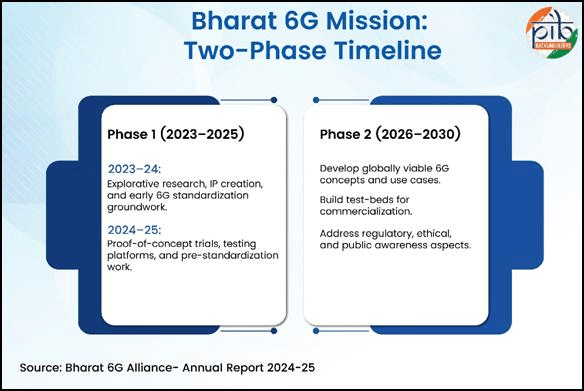
On March 22, 2023, the government released the “Bharat 6G Vision” manifesto, charting a course for India to become a frontline contributor in the design, development, and deployment of 6G technology by 2030.
To translate this vision into reality, the government has launched several key initiatives:
- Funding Advanced R&D: Establishment of two state-of-the-art testbeds for 6G THz and Advanced Optical Communication.
- Building a 6G-Ready Ecosystem: Sanctioning 100 5G labs at academic institutions across India to foster skills, research, and startup innovation.
- Promoting Research: Approval of 104 research proposals focused on building a robust 6G network ecosystem.
Bharat 6G Alliance: Forging a Collaborative National Effort
The Bharat 6G Alliance (B6GA) is a cornerstone of this mission, bringing together Indian industry, telecom service providers, academia, and research institutions. This collaborative platform is driving indigenous R&D to create a self-reliant and globally competitive telecom ecosystem.
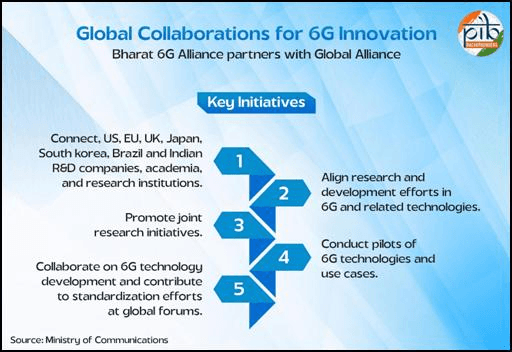
In a significant move towards global cooperation, the B6GA has signed Memoranda of Understanding (MoUs) with leading international research alliances, including the NextG Alliance (USA), 6G IA (Europe), and the 6G Forum (South Korea). These partnerships aim to foster collaborative research, standardization, and the development of secure, trusted telecommunications technology.
Spotlight on Progress: India Mobile Congress 2025

The International 6G Symposium held at the India Mobile Congress (IMC) 2025 served as a major milestone, showcasing India’s growing prowess in telecom innovation. The event highlighted the country’s indigenous 4G/5G stacks as the foundation for a secure and scalable 6G future.
Key announcements at the symposium included:
- The release of a Joint Declaration on 6G Principles.
- New MoUs between the Bharat 6G Alliance and NASSCOM and the European Space Agency.
- The unveiling of four strategic whitepapers on Spectrum Roadmap, Powering Next-Gen Telecom, AI in Network Evolution to 5G, and 6G Architecture, Security, and Exposure Framework for RF Sensing.
Building Blocks for a 6G-Ready Nation
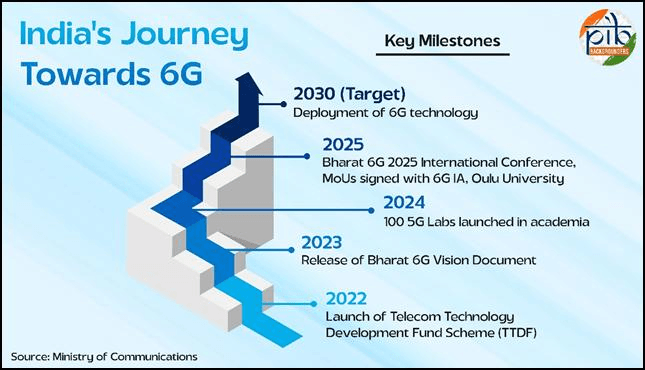
The government is implementing a multi-pronged strategy to cultivate a future-ready telecom ecosystem:
- 100 5G Labs Initiative: Creating a nationwide network of innovation hubs in academic institutions to build talent and encourage industry-academia collaboration, making the startup ecosystem 6G-ready.
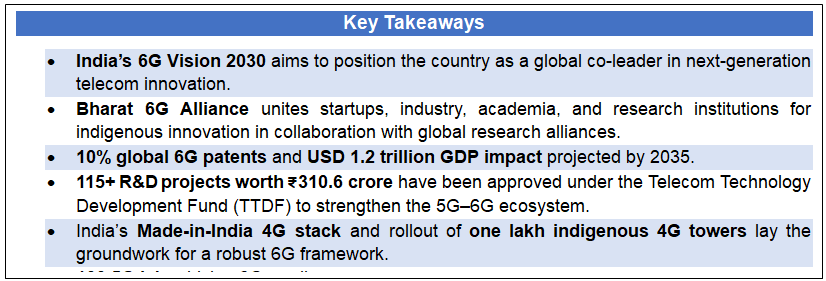
- Telecom Technology Development Fund (TTDF)1: A scheme to fund domestic R&D, with 115 projects related to 5G and 6G worth over ₹310 Crores already approved.
- Technology Innovation Hub at IIIT-B2: Focused on developing core intellectual property for 5G-Advanced and 6G systems, including Reconfigurable Intelligent Surfaces and O-RAN technologies.
Conclusion: A Connected, Self-Reliant Future
India’s concerted push for 6G leadership, underscored by strategic initiatives and global partnerships, marks a definitive shift from technological adoption to innovation. By fostering a secure, inclusive, and indigenous digital infrastructure, India is not only strengthening its own economy—projected to see a USD 1.2 trillion GDP contribution from the telecom sector by 2035—but is also poised to shape an equitable and connected global future.
These efforts collectively reinforce the nation’s journey towards achieving the Viksit Bharat 2047 vision, ensuring that the benefits of the digital revolution reach every citizen.
Sources: Ministry of Communications, PIB Releases, Bharat 6G Alliance, Department of Science & Technology.
Also Read : What is 6G? Overview of 6G networks & technology – By techtarget.com
Visit https://inworldnews.com/ for more.
- The Telecom Technology Development Fund (TTDF) is an Indian government scheme that funds research and development for affordable rural broadband and mobile services. It aims to promote indigenous technology by supporting R&D, design, and commercialization by domestic companies, institutions, and startups, while also fostering collaboration between academia, industry, and research bodies. Funded by a percentage of annual collections from the Universal Service Obligation Fund (USOF), the TTDF seeks to build a self-reliant telecom ecosystem and reduce reliance on imports.
Key objectives
Promote indigenous technology:
Encourage the design, development, and commercialization of telecom products and solutions by Indian entities.
Enable affordable services:
Support the goal of providing affordable broadband and mobile services in rural and remote areas.
Foster innovation:
Create a collaborative ecosystem for research, design, and innovation involving academia, start-ups, MSMEs, and research institutions.
Reduce imports and boost exports:
Promote technology ownership and indigenous manufacturing to reduce dependence on imported technologies and create export opportunities.
Support future technologies:
Fund projects related to advanced technologies like 5G and 6G.
Funding and implementation
Funding source:
5% of the annual collections from the Universal Service Obligation Fund (USOF) are allocated to the TTDF.
Implementation agency:
The Department of Telecommunications (DoT) is the implementing authority. For certain technology-intensive projects (TRL > 3, requiring funding > INR 10 Crore), the Centre for Development of Telematics (C-DOT) serves as the implementation agency, facilitating and driving the research and development process.
Focus areas
Rural-specific communication technology applications
Affordable broadband and mobile services
5G and 6G technology
IoT/M2M communication
Development of components like semiconductor SoCs and modules
Pilot and field trials of products ready for commercialization ↩︎ - The Technology Innovation Hub (TIH) at IIIT Bangalore is named the IIITB COMET Foundation and focuses on developing Advanced Communication Systems, with an emphasis on 5G-Advanced and future 6G networks. Established under the National Mission on Interdisciplinary Cyber-Physical Systems (NM-ICPS), its goal is to produce indigenous technology, generate intellectual property (IP), and foster product innovation.
Key focus areas and projects at the IIITB COMET Foundation include:
6G Network Technology: The hub’s central mission is to develop foundational technologies for future 6G systems, addressing national and international needs for advanced communication.
Intelligent Surfaces: Researchers are working on Reconfigurable Intelligent Surfaces to improve coverage, capacity, and sensing capabilities in wireless networks.
Open-RAN Massive MIMO: The hub is developing Open Radio Access Network (O-RAN) Massive Multiple-Input Multiple-Output (MIMO) technology.
Intellectual Property: A major goal is to produce indigenous research that creates product IP for commercial use and to generate patents for incorporation into future wireless standards.
IIITB Innovation Centre
In addition to the COMET Foundation, IIIT Bangalore also hosts the IIITB Innovation Centre (IIITB IC), which has been fostering the startup ecosystem since 2009.
The Innovation Centre:
Supports startups: IIITB IC provides ventures with mentorship, technical guidance, funding opportunities, and infrastructure.
Focuses on digital technologies: The center promotes innovation in areas such as Software as a Service (SaaS), Platform as a Service (PaaS), IoT, Artificial Intelligence (AI), and Blockchain.
Operates funding programs: Through initiatives like the TIDE 2.0 Fund, it offers funding to entrepreneurs to help them validate ideas or accelerate the development of prototypes.
Partners with various stakeholders: It brings together entrepreneurs, academic experts, government agencies, and industry partners to collaborate on socially relevant digital solutions.
Other related initiatives
The institute is also known for other innovation-focused projects, including:
MOSIP (Modular Open Source Identity Platform): This project, based at IIIT-B, is a digital identity platform used by national governments and offers an open-source framework for digital transformation.
Industry collaboration: IIIT Bangalore is recognized for its strong ties with the tech industry, which helps students with internship and placement opportunities. ↩︎